History of the Trail and Race
Origin story of the Colonial Greenway and Paine to Pain
Getting this race off the ground took six years. Here is why.
Exploring trails in Westchester
After moving to Westchester in 1999, I discovered a variety of local trails that were great for running. But they had no maps, were spread across New Rochelle, Larchmont, Mamaroneck, Scarsdale, Eastchester, and County lands, and had no formal integration with each other. Two parks were right next to each other on county maps, but had no linking trail.
By 2001, I had run each of the various trails separately, learning as I went, and sometimes getting lost. And then one day I strapped on a water bottle and took off from home as I stitched them together into a 13-mile loop. While others were running on asphalt, I had soft earth, cool air, and a perfect marathon training ground. Except, of course, for those times I had rocks, roots and mud. I came home dirty and happy.
And I let my city councilman know. Noam Bramson, who went on to become mayor of New Rochelle, went from municipality to municipality to see what he could do. He, in turn, found that Mamaroneck Town Councilwoman Nancy Seligson was already doing the same thing to organize the trails into a system of some kind. That was 2002.
Meetings and more meetings

A new connecting trail was built in Saxon Woods on December 3, 2005, to bring it closer to the Leatherstocking Trail.
Over the next six years we kept meeting (and meeting and meeting) and I kept running the trails, giving guided running tours to friends and members of the Sound Shore Runners and Multisport Club (now NewRo Runners). And at each municipal meeting I said that if they built the missing link between the two parks that were next to each other (Leatherstocking and Saxon Woods) our club would put on a half-marathon trail race. If you build it, I told them repeatedly, they will run.
The first trail of the race is the Leatherstocking, a 2.7-mile linear park going from New Rochelle to Mamaroneck. This was created from land originally set aside for a roadway, but converted to a nature trail when I-95 was built.
Unfortunately, in the big April 15, 2007, Nor’easter, floodwaters wiped out a huge, critical catwalk on the Leatherstocking. Falling trees pulverized another catwalk that spanned a stream. Elizabeth Paul, The Town of Mamaroneck’s environmental coordinator, set to work with volunteer crews of Boy Scouts to repair the walk, rebuild the bridge, and mark the Leatherstocking with a new star blaze.
Connecting the trails and parks
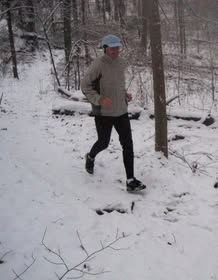
Guillermo Gutierrez on the December 3 trail, one day after it was built.
Meanwhile, the Town of Mamaroneck and Westchester County were building that important connection between the Leatherstocking and Saxon Woods, the huge county park just to the north. The parks were thisclose to each other, but pedestrians were required to go a half mile on Old White Plains Road — a narrow, winding roadway with no shoulder — before finding an unmarked access trail into Saxon Woods.
The missing link between the parks was built on December 3, 2005, with volunteers cutting a new trail into Saxon Woods so that only 500 feet of running was required on Old White Plains Road. (I then ran the finished loop the next day, on freshly fallen snow, with Guillermo Gutierrez.) The narrow December 3rd trail twists and turns its way into the park for a quarter mile to meet up with the substantial trail system that already exists there.
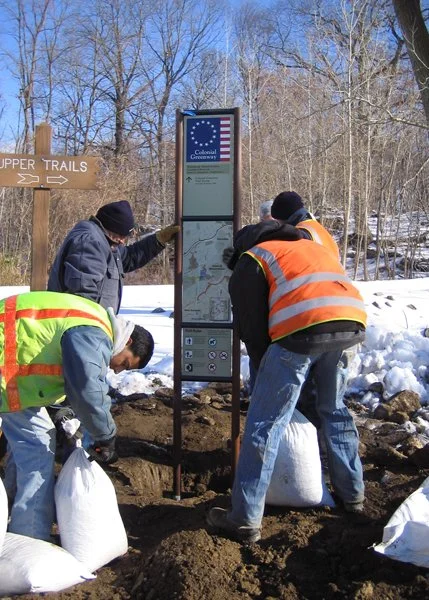
Newly created signs and maps were installed throughout the system in the winter of 2007-’08.
In the winter of 2007-’08, that 500-foot run on Old White Plains Road was closed even further by the Town of Mamaroneck with a gravel path along a newly built shoulder that eliminated almost all of the previously dangerous connection. It wasn’t pretty, but it safely linked the parks.
At the same time signs went up around the trail system. This included existing (but unmarked) connections to the Hutchinson River Trail (an old bridle trail) that runs through the woods abutting the southbound side of parkway, into Twin Lakes park in Eastchester, and then on to Nature Study Woods in New Rochelle (an old railway right of way). That’s right, the disparate elements had become a unified system, now called the Colonial Greenway as a tip of the hat to our colonial history.
Finding the funding
On the county level, $1.5 million was promised for the trails in December 2006, of which $500,000 was to be spent on a trail parallel to Pinebrook Boulevard to make a giant figure-8 out of the system, and $1 million for trail improvements to the rest.
While it took six years, the group of local officials secured funding for the signage, built and mapped trails, repaired storm damage, fixed drainage issues, and committed substantial additional funds for the Greenway. Mayor Bramson predicted that “The Colonial Greenway will quickly become one of our region’s great open space and recreational resources.” And Councilwoman Seligson said, “After years of hard work and planning, we can now look forward to opening the Colonial Greenway to our entire extended community.”

Soft opening, May 18, 2008.
On May 18, 2008, 20-plus runners met at the Thomas Paine Cottage in New Rochelle and had a “soft opening” of the trail. In a June meeting of local officials, an official dedication date was set for September 28. Our little running club had three months to put together a half-marathon trail race that no one had ever heard of on a trail system that had not previously existed.
The first P2P race

New Rochelle Mayor Noam Bramson dedicates the new Colonial Trail, minutes before the inaugural race starts in 2008.
And on September 28 we did just that, with the help of dozens of volunteers and the assistance of local municipalities. Despite several days of inclement weather, 50 hearty souls toed the start line at the base of Broadview Avenue in New Rochelle. And with a gunshot from a colonial musket, we started down the trail to what we hoped would grow into a signature event for the County of Westchester.
The race starts at Paine Cottage, a national landmark that sits on Thomas Paine’s former farm, given to him by the State of New York for his activism in the Revolution. The house and adjacent park sit at the bottom of Broadview Avenue.
Ragtime author E.L. Doctorow also lived on Broadview, until 1999, and he immortalized the street in the opening of his now-famous book: “In 1902, father built a house at the crest of the Broadview Avenue hill in New Rochelle, New York.”
This hill is the start of our race.
—Eric Turkewitz